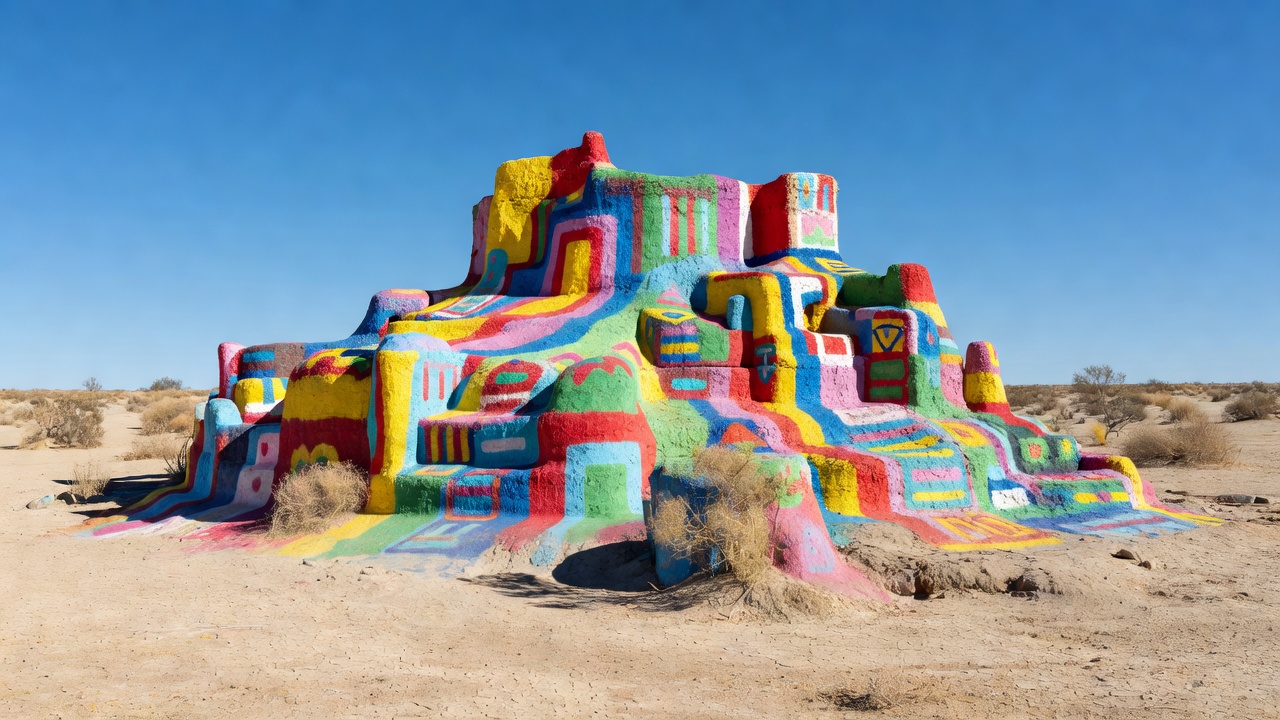
The Journey to Niland
Salvation Mountain is located near Niland, a town that has seen better days, adjacent to the Salton Sea—an environmental disaster masquerading as a lake. To get here, you are committing to a roughly three-hour drive from San Diego or Palm Springs. The landscape becomes increasingly desolate, giving the sudden appearance of the neon-painted monument a surreal, mirage-like quality.
The mountain is situated at the entrance to Slab City, an off-grid squatter community built on the concrete slabs of an abandoned World War II Marine base. This context is important; you are not pulling into a state park with manicured lawns and a visitor center. You are pulling into the harsh, unregulated fringe of American society.
The Aesthetic Experience
The site itself is a sprawling, labyrinthine structure. Biblical verses and messages of universal love are painted over every conceivable surface. Knight built "rooms" out of donated bales of hay, covering them in adobe and paint to create cave-like alcoves. It is undeniably a masterpiece of outsider art—raw, unpolished, and visually overwhelming.
Since Knight's passing in 2014, a non-profit organization has taken over the Sisyphean task of maintaining the mountain. The extreme desert heat constantly cracks and bleaches the paint, requiring endless patching and repainting by volunteers. The fragility of the site means visitors are restricted to walking on the "Yellow Brick Road" pathway to avoid damaging the softer adobe sections.
The Reality of the Environment
Visiting Salvation Mountain means battling the elements. Summer temperatures routinely soar well past 110°F (43°C), and there is virtually no shade. The smell of the decaying Salton Sea often hangs heavy in the air depending on the wind direction. Furthermore, the dust is pervasive.
The Good
- Completely unique piece of American outsider art
- Free to visit (donations encouraged)
- Visually stunning for photography
- Proximity to the fascinating off-grid Slab City
The Bad
- Extremely remote location
- Brutal desert heat for most of the year
- No traditional amenities (bathrooms, water)
- Deterioration of the site means limited access areas
Practical Information
Preparation is mandatory for this detour. You cannot rely on local infrastructure.
| Best Time to Visit | December to February. Avoid summer entirely. |
|---|---|
| Cost | Free, but paint or cash donations are highly appreciated to fund maintenance. |
| Necessities | Bring significantly more water than you think you need, and ensure a full gas tank before leaving major highways. |
| Facilities | Zero plumbing. Portable toilets may or may not be available and serviced. |
The Verdict: Worth It?
Salvation Mountain is not a casual detour. It is a pilgrimage for lovers of folk art, strange Americana, and desert oddities. If your idea of a good trip involves predictable amenities and comfort, skip this entirely. But if you are drawn to the bizarre and the dedicated—and you happen to be in Southern California during the winter months—it is an unforgettable testament to one man's vision, standing stubbornly against the punishing desert elements.